The Art
Shorin-ryu — the Shaolin school of Okinawa
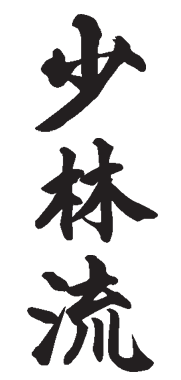
Shorin-ryu (少林流) is one of the major martial arts of Okinawa, and one of the oldest schools of karate in the modern world. The name is the giveaway: the characters Shōrin are the Japanese reading of Shaolin. The art is a marriage — Shaolin kung fu carried across the sea, joined to Shuri-te, the fighting tradition of Shuri, the old royal capital of the Ryukyu Kingdom.
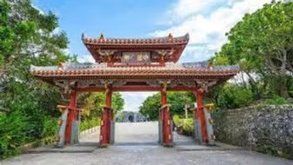
And it was never a peasant's art. Shuri-te was the guarded discipline of Okinawa's noble warrior class — palace guards, diplomats, and court officials of the Ryukyu court, men with the standing and the education to study a complex system and carry it abroad. That bearing is still in the training: formal, precise, and carried with court manners.
The Line
From the palace guard to Waukesha
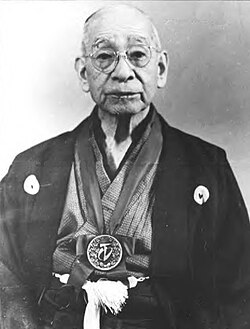
- Matsumura Sōkon — master of Shuri-te; bodyguard to three kings of Ryukyu, called the Miyamoto Musashi of Okinawa.
- Ankō Itosu — Matsumura's student, who carried Shuri-te into the modern age.
- Chōshin Chibana — Itosu's top student. In 1933 he gave the style its name, Shorin-ryu, in honor of its roots; his school is known as Kobayashi-ryu.
- The Shōrinkan — a branch of Chibana's school, the line of Shūgorō Nakazato, one of the art's notable masters.
- Jaysen D. Wolf — 6th dan in the Shorinkan line, still training in it every year of his life.
That is the whole chain — no borrowed names, no invented pedigree. When Jaysen teaches, this is the line standing behind him.
The Craft
How the art trains
Shorin-ryu is characterized by natural breathing and natural, narrow, high stances — and by circular movement rather than direct force. The teaching is to move quickly, evade with fluid motion, and keep a structure solid enough to make a block or a strike land with the whole body behind it. Even the punch is its own: neither horizontal nor vertical, but canted slightly inward, aligning the bones of the arm for a faster, more stable strike.
The curriculum is carried in kata — the formal patterns that hold the art's knowledge. The kata of Shorin-ryu, as the public record lists them:
- The doorway in — the Fukyugata and Kihon series, the first forms a student learns.
- The core — Naihanchi in three, Pinan in five (the name means peaceful mind), Passai, Gojushiho, Chinto, Kusanku, and Jion.
- In some schools — Seisan, Ananku, Wankan, Rohai, and Wanshu are taught as well. The branches of Shorin-ryu share most of the set, with small differences from line to line.
Rank is earned the slow way: the dan system came to Okinawa in 1960, and testing — shinsa — examines a student in basics, sparring, kata, and bunkai, the living application of the forms.
The Weapons
Okinawa kobudo — the other half of his rank
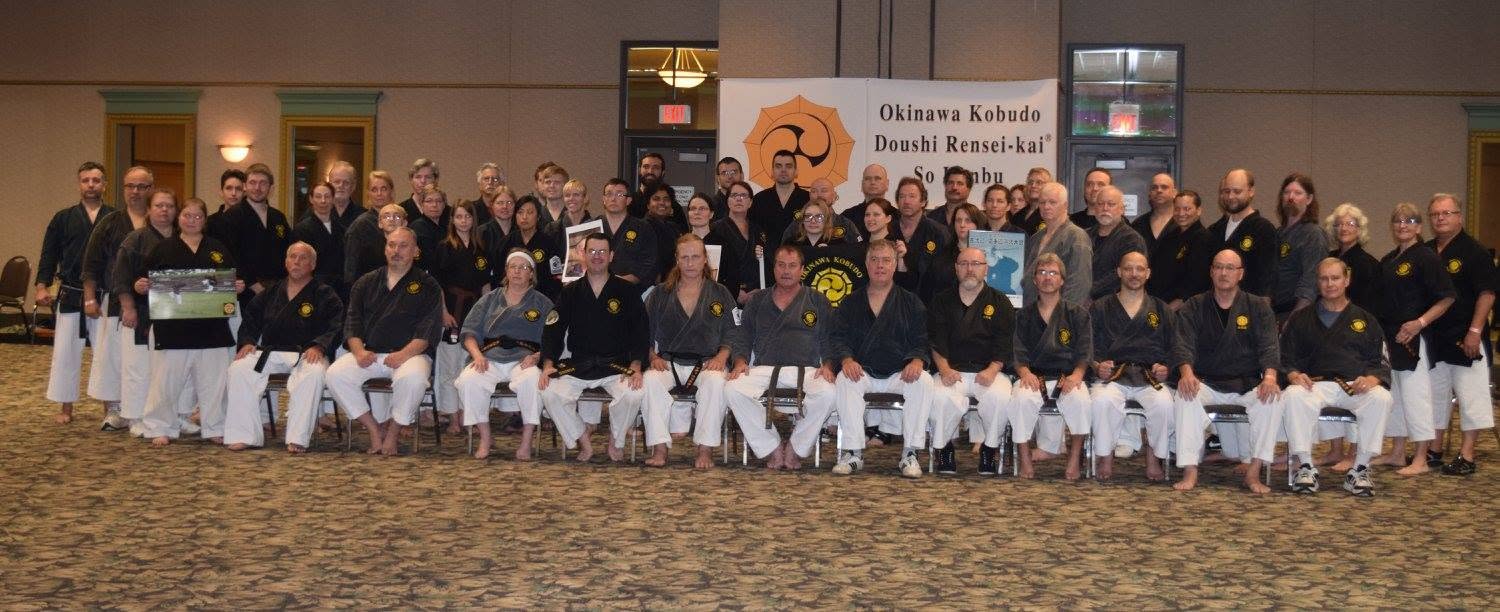
Alongside the empty hand, Jaysen carries a 5th dan in Okinawa Kobudo, graded in 2014 — the traditional weapons art of the same Okinawan world. Weapons study in Shorin-ryu generally begins at dan level, and it has the same aristocratic root as the empty hand: the sai was the truncheon of palace police, the bo the staff of the kingdom's law-enforcement officials. These were the tools of men charged with keeping the peace — which is worth remembering when you look at the rest of this site. The photograph above is a gathering of the Okinawa Kobudo Doushi Rensei-kai, the kobudo family of Jaysen's fifth dan: a room full of people, on two sides of the ocean, keeping the same art.
The Film
Eizo Shimabukuro — a master of the wider family
The film is an old demonstration tape, and it looks like one — the picture is worn; the master is not.
This film is historic demonstration footage of Eizo Shimabukuro (1925–2017), founder of Shobayashi Shorin-ryū — a sister branch of the same Okinawan Shorin-ryu family that Jaysen's Shorinkan descends from. Shimabukuro was the younger brother of Tatsuo Shimabukuro, who founded Isshin-ryū, and he trained under some of the greatest masters of his age: Chotoku Kyan and Choki Motobu in the Shuri-te line, Chojun Miyagi of Goju-ryū, and Shinken Taira in kobudo. Through Nakazato, he also received the Pinan and Naihanchi kata from Chibana's line — which is where his art and Jaysen's touch: both drink from Chibana's well.
His Shobayashi blends those inheritances — Kusanku and Passai from Itosu's tradition, Pinan and Naihanchi from Chibana's, Seiunchin and Sanchin from Miyagi's — and keeps the family's close-range character: joint locks, pins, throws, and ground work alongside the strikes. In 1959, Kanken Toyama promoted him to 10th dan, the youngest master of his time to hold it.
He is not Jaysen's teacher, and this is not Jaysen's branch. The film belongs here because the art is one family with many houses — and because watching a master of Shimabukuro's generation move is the quickest way to understand what Jaysen's tradition values.
Learn it from inside the line
This is the art Jaysen teaches — in private homes, in gyms, and on his own floor.
Book Jaysen →The full public history of the style — its branches, kata, and masters — is kept on Wikipedia: Shōrin-ryū. This page follows that record.